

Handy “Heroic Journey” Structure Chart
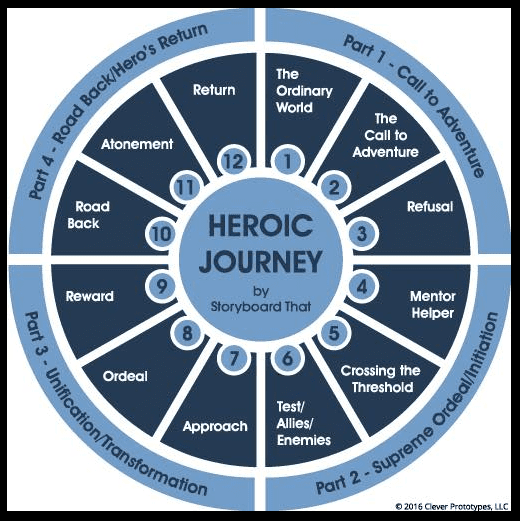
Well, hello, AWESOME! Many thanks to Storyboard That for this super useful graphic.
And what is this thing? Why, it is your feature screenplay structure at a glance. We here at Coverage Ink are big fans of the Hero’s Journey, aka mythological structure for movies. Most contemporary movies are based on it, as are bestselling screenwriting how-to books “The Writer’s Journey” and “Save the Cat!” So many of the feature scripts we read would be improved if they simply knew and followed the principles of the hero’s journey.
Please, folks, don’t reinvent the wheel. It’s been around for a long time and it works really well already. That said, you’re welcome to springboard off of it and do your own thing, by all means. But you need to know your rudiments first before you can solo.
Now this graphic may take a bit of explanation, so for that we send you off to the aforementioned two books. Ingest them, savor them. Then rejoice in knowing that the guesswork has been taken out of movie screenplay structure. You can pick them up at www.writerstore.com. They are required reading in Hollywood. Do yourself and your writing career a big favor and learn this stuff cold.
–Jim C.
Coverage Ink

F.A.Qs
Does the Hero’s Journey work for every genre, or mostly for adventure/fantasy?
Beyond fantasy, the Hero’s Journey applies to any genre by mapping universal human transformation. In dramas or romances, the “quest” simply shifts from a physical journey to an internal, emotional one, which provides a reliable foundation for any character-driven story.
Hero’s Journey vs. Three-Act Structure: what’s the key difference, and which should you use?
The Three-Act Structure is the script’s technical skeleton, managing plot pacing and timing. In contrast, the Hero’s Journey is its emotional soul, tracking the protagonist’s growth. These should be used together to balance the story’s external “how” with its internal “why.”
How do you map Hero’s Journey beats to page numbers in a 110-page feature screenplay?
In a 110-page script, Act I concludes around page 28 with the First Threshold. The Midpoint Ordeal typically lands near page 55, while the Resurrection climax occurs around page 100. This alignment ensures that the character’s internal shifts match the story’s physical pacing.
In an ensemble story with multiple leads, how do you decide who the “hero” is?
The primary hero is the character whose choices most directly drive the plot or who undergoes the most significant transformation. In an ensemble, you can identify the lead by determining whose failure would most impact the story or whose emotional stakes are most central to the resolution.
How can you use the Hero’s Journey without your script feeling “formulaic”?
To avoid a formulaic feel, treat the framework as a flexible guide rather than a rigid checklist. Subverting common tropes, such as introducing an unreliable mentor or reordering specific beats, ensures the narrative feels driven by unique character motivations rather than a predictable template.